Fusing
Perfect connection, maximum stability
Discover MEYER’s leading fusing machines for the clothing industry, with customized solutions and industry-leading expertise.
MEYER Machines
The right machine for your purpose. Made in Germany.
Applications
MEYER machines are suitable for a wide range of applications.
Industries
Industries that rely on MEYER machines.
Service
Production, development and support.
Production of small series
Production of individual metal parts
Concept, machine and system development
Support, spare parts and accessories
Experience our machines live in the Test Center: Test, optimize and perfect your production before you invest. This is our joint path to a customized solution.
MEYER Maschinenfabrik
Get to know the company behind MEYER better.
Family business since 1949
All important news & exhibitions
Your future with MEYER
Discover MEYER’s leading fusing machines for the clothing industry, with customized solutions and industry-leading expertise.
Find the right machine for your requirements.
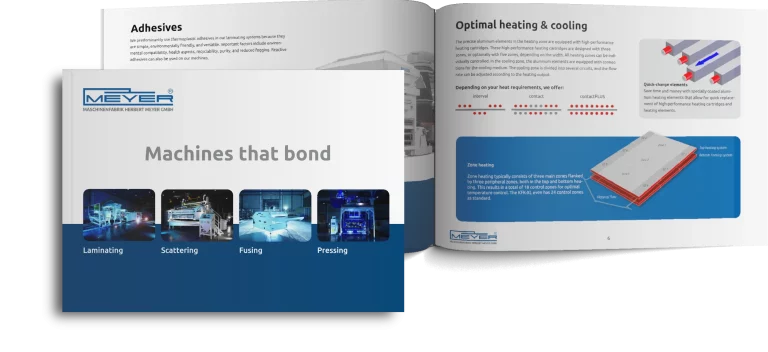
Sign up and you will receive all relevant information about our laminating machines in a brochure.
Expand your machine with our in-house peripheral equipment and increase the safety and profitability of your production.
Would you like to see MEYER quality live? Schedule appointments at the test center and test your application.
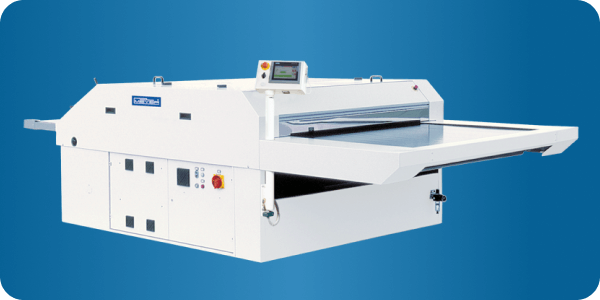
Fusing is a method of bonding fabrics and thin flexible materials in the clothing, automotive and furniture industries. A thermoplastic adhesive is melted between two flexible materials and the compound is fused using pressure rollers. Unlike laminating, there is no cooling phase. Therefore, only bonding is possible, not coating.
Find out how our fusing technology binds your materials by applying targeted heat and pressure for protected connection. Depending on the production requirements, continuous or discontinuous processes are used.
Efficiency for series production
Continuous fusing machines are designed for high production volumes and enable uniform, automated treatment. The material is fed between belts through the heating and pressing zone, where a thermoplastic adhesive is melted between the layers and immediately fused. This continuous process ensures high throughputs and consistent quality – ideal for mass production in the textile, automotive and furniture industries.
Flexibility for individual batches
In contrast, discontinuous fusing machines work in batch processes. Here, cut materials are fed individually from the stack into the machine and fused using defined heating and pressing cycles. This method enables precise adaptation of the process parameters so that even sensitive or widely varying materials can be optimally treated. Discontinuous machines are particularly suitable for custom-made products, smaller batches or materials with specific requirements such as high pressures.
Find out how our fusing machines help companies in various industries to succeed every day.
MEYER fusing machines can be used for a wide variety of fabrics.
MEYER offers customized solutions for the treatment of the sensitive natural material leather, suitable for every volume and every process. Laminating leather results in advantages such as a softer handle (soft touch), improved haptics, less wrinkling, increased form stability, uncomplicated and easier further processing.
MEYER has its roots in the manufacture of machines for men’s and women’s clothing and today offers fusing machines for almost every application in the clothing industry. We can also meet the highest quality standards. This high quality standard sets MEYER apart from other suppliers.
Our fusing machines can be specially configured for the production of shirt collars. Functions such as double printing, cooling systems in the unloading belt, light tables, return belts and stacking devices make the process more efficient.
In the clothing industry, “fusing” refers to the process of bonding a liner to the back of the fabric. This stabilizes the fabric and makes it appear smoother. Liners are typically fused using heat, particularly on the front of a jacket or on a shirt collar. The liner is usually a nonwoven or a fabric. The liner is coated with a thermoplastic adhesive. Historically, before fusing, the liner was sewn in or quilted.
A fusing machine can be used to fuse liners to the back of the fabric. This can be done over the entire surface of rolled goods, or the liner can be placed precisely on cut-to-size pieces of fabric and fused in place.
Approximately 400 mm should be allocated for each operator. Standard fusing machines are typically 1,000 mm wide and designed for two operators, with one person on each side. For high-volume fixing operations, a 1,400- or 1,800-mm-wide machine may also be appropriate.
Any type of part can be loaded into a continuous-flow fusing machine. Even very long parts can be fused. The finished parts can be automatically stacked and conveyed back. The continuous-flow fusing machine is highly efficient because there are no waiting times.
With a press, on the one hand, the size of the press limits the length of the parts being fixed, and on the other hand, you have to wait until the press finishes the fixing process. This can be optimized with movable loading tables, but in terms of efficiency, the continuous-feed machine is better.
Fabrics and liners are cut in stacks. To automate the process, a layer must be removed from the stack. This cannot be done automatically without errors, since the individual layers of fabric are often stuck together as a result of the cutting process.
Get in contact with us today to find out how our fusing machines can revolutionize your production processes.