Laminating
Laminating machines that join materials.
From activated carbon filters to leather seats – laminating machines from MEYER change your production level.
MEYER Machines
The right machine for your purpose. Made in Germany.
Applications
MEYER machines are suitable for a wide range of applications.
Industries
Industries that rely on MEYER machines.
Service
Production, development and support.
Production of small series
Production of individual metal parts
Concept, machine and system development
Support, spare parts and accessories
Experience our machines live in the Test Center: Test, optimize and perfect your production before you invest. This is our joint path to a customized solution.
MEYER Maschinenfabrik
Get to know the company behind MEYER better.
Family business since 1949
All important news & exhibitions
Your future with MEYER
From activated carbon filters to leather seats – laminating machines from MEYER change your production level.
Find the right machine for your requirements.
Sign up and you will receive all relevant information about our laminating machines in a brochure.
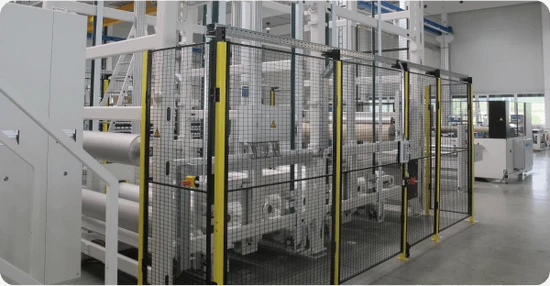
Expand the performance of your laminating machines with additional peripheral equipment.
Schedule an appointment at the Test Center and convince yourself of MEYER quality with your application.
Find out how our lamination technology bonds your materials in a protective manner.
Ideal for industrial applications.
Flatbed laminating machines enable precise lamination of various materials. A targeted combination of heating, pressure and cooling zones ensures optimum treatment of the material. The result: high efficiency, precise alignment and even pressure distribution for high-quality, bubble-free bonds.
Ideal for versatile productions
The calender laminating technology uses large heatable rollers for laminating films or delicate textiles. This process ensures uniform quality without tape marks and marks.
Ideal for composite materials
High-pressure laminating joins materials such as textiles, foamed materials or films using high pressure, heat and adhesive. The process is suitable for creating robust products, e.g. for the automotive industry. The flexibility and strength of the end products can be controlled.
Our laminating system solutions use thermoplastic hotmelt adhesives that are versatile, non-polluting and easy to use. We take varietal purity, environmental and health protection, recyclability and fogging into account. We also use reactive adhesive systems for special requirements.
Find out how our laminating machines help companies in various industries to succeed every day.
From roof films to carbon coatings – discover the wide range of possible applications.


The challenge in the production of activated carbon filters is the combination of several scattering machines or their arrangement in the system layout. MEYER offers a wide range of modular concepts to meet filter designs and purposes.
MEYER offers customized solutions for the treatment of the sensitive natural material leather, suitable for every volume and every process. Laminating leather results in advantages such as a softer handle (soft touch), improved haptics, less wrinkling, increased form stability, uncomplicated and easier further processing.
Carbon poses a number of challenges in mechanical engineering as it is abrasive and electrically conductive. MEYER has developed innovative solutions, including powder scattering machines that are combined with infrared heating fields to create stand-alone machines.
MEYER machines can be used to laminate membrane or multilayer films onto textiles or rigid substrates, using thermoplastic adhesives or the membrane film itself as a bonding agent as required. The core of the production line is a laminating machine equipped with modern winding technology.
This classic laminating task involves the roll-off of two or three rolls of material, which are treated in a laminating machine and then rewound. With two rolls, it is a coating process, e.g. coating foam with self adhesive film, while with three rolls, the middle roll serves as a thermoplastic adhesive that joins two materials. This process can also be carried out with solid materials in panel form.
For this application, fiber materials are equipped with a thermoplastic matrix, whereby the flow behavior of the adhesive is precisely adjusted to optimally enclose the fibers. MEYER develops laminating machines that can produce the necessary surface and linear pressure to meet these requirements.
Our laminating systems enable the production of glass mats for a wide range of applications. Glass rovings are cut to a defined length using a roving cutter and distributed onto carrier material in a specified grammage. After the application of thermoplastic adhesive powder, the material is fed into the laminating process, where carrier-free glass mats can also be produced.
In classic carpet coating, thermoplastic powder is applied to the back of the carpet in a high grammage, whereby the powder composition varies. The powder is then melted and recooled using a calender or flatbed system to complete the coating process.
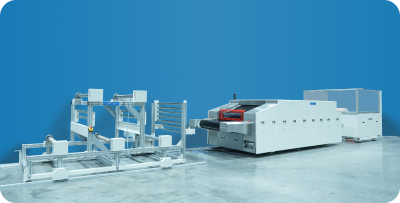
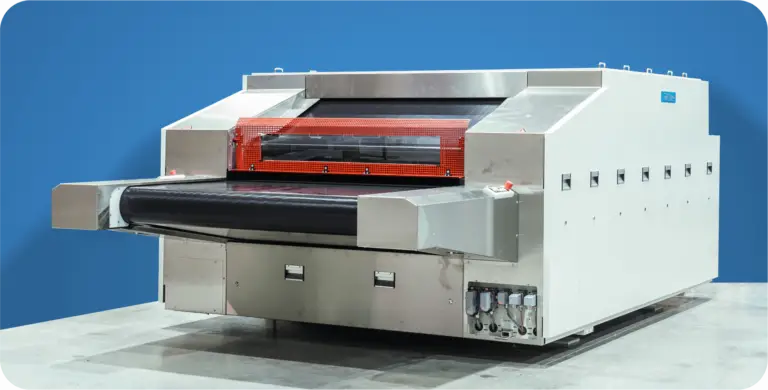
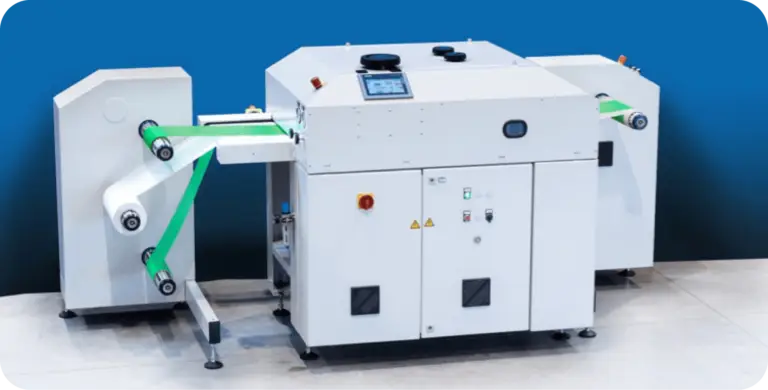
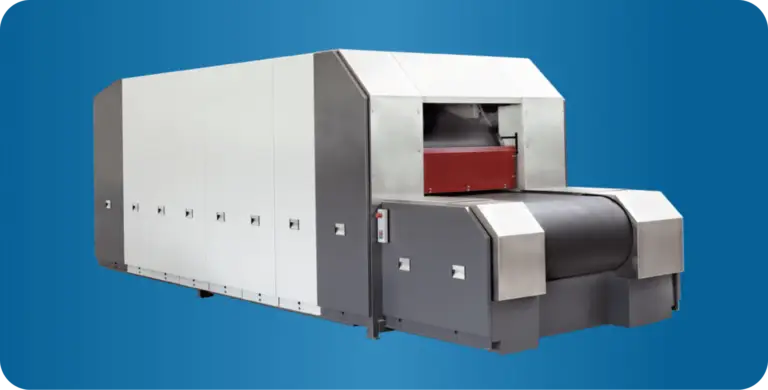
A flatbed laminating machine, also known as a double-belt press, consists of two conveyor belts arranged one above the other. The adjustable gap between the two conveyor belts is the laminating gap through which the material to be laminated is conveyed. Inside the conveyor belts are a heating plate and a cooling plate to heat and then cool the material being laminated. This typically activates a fusing adhesive to bond the materials together. The cooling system stabilizes the compound. Since the laminating gap is flat, both flexible, rollable materials and rigid sheets can be treated. Meyer specializes in flatbed laminating machines and also offers laminating trials at its technical center.
Flexible materials, such as textiles, nonwovens, films, or foams, can be bonded together. Multiple layers can be bonded in a single operation. Sheets can also be bonded. A thermoplastic adhesive is usually used for this purpose.
Production speed depends primarily on the materials. Thick, heavy materials often require a lot of heat energy, which results in a slower production speed. The longer the heating zone of the laminating machine and the greater the installed heating power, the faster the production speed. Typical production speeds range from 2 to 20 m/min.
A flatbed laminating machine with an integrated cooling zone is ideal for coating. The coating is usually a thermoplastic adhesive that is laminated on as adhesive powder, film, or woven material. Since the coating is completely cooled before leaving the machine, it does not bond to the conveyor belts.
A calender consists of several rollers that heat and press the material to be laminated. In a belt laminator, the heating zone is longer, and temperature control is more precise thanks to adjustable zones. The surface pressure can be precisely adjusted, allowing for the lamination of both thin, flexible materials and hard sheets. An integrated cooling zone enables immediate cooling, which offers numerous advantages; in particular, it allows materials to be completely melted. In a calender, the fusing adhesive must always be covered.
First, dual-belt laminating machines differ in width and in the length of their heating and cooling zones. There are machines for simple applications where the production speed is relatively low, and there are high-performance machines for heavy materials where high pressures and high speeds are required. At MEYER, the machines can be categorized as follows:
Depending on the machine type, the material to be laminated can be up to 150 mm thick. Custom solutions are available upon request. If the material is very thick and needs to be heated through completely, the machine must run at a slower speed. However, if a thin material is laminated onto a thick carrier material, heating the thin layer is usually sufficient, allowing for a much higher production speed.
The type description indicates the maximum passage width. However, the material should always be approximately 100 mm narrower. With a KFK-E 1900, material up to 1900 mm can theoretically be fed into the machine; however, trouble-free lamination is only guaranteed for material up to 1800 mm. The maximum material width for the KFK-XL is 3000 mm. Wider solutions are available upon request.
At MEYER, you will find the right machine to turn your production goals into reality. Make an inquiry and let us talk.